
R-410A to R-32, What Maryland Homeowners Need to Know

Key takeaway: New residential heating and cooling equipment moved off R-410A because EPA's Technology Transitions rule set a global warming potential ceiling of 700 for residential and light commercial systems, and R-410A sits at 2,088 against R-32 at 675 in EPA's own reference table. R-32 is classified A2L, meaning lower toxicity and the mildest flammability category the ASHRAE safety standard recognizes, which is why new equipment carries a factory installed refrigerant detector and a fan driven mitigation response. The expensive consequence for homeowners is the one rarely mentioned up front. An R-32 outdoor unit cannot be paired with an R-410A indoor coil, since the metering device, the coil match, the AHRI tested rating and the safety listing all break, so the partial replacement that used to save a homeowner money on an R-410A era system is no longer on the table. The system you already own remains legal to run and legal to service, and EPA has said the rule does not limit use of existing equipment. TerraStream Energy installs Daikin and Goodman systems on R-32 across Maryland with Prince George's County first, as whole system replacement or as a conversion off gas heat onto an electric heat pump, and writes the refrigerant, the full model numbers and the AHRI reference number on the proposal so a homeowner can check the match before signing.
What a Refrigerant Does and Why Yours Is Changing
What Refrigerant Actually Does in a Split System
Refrigerant is not a fuel and it is not consumed, it is the working fluid that carries heat from one side of your wall to the other, and a split system charged correctly will never need more of it.
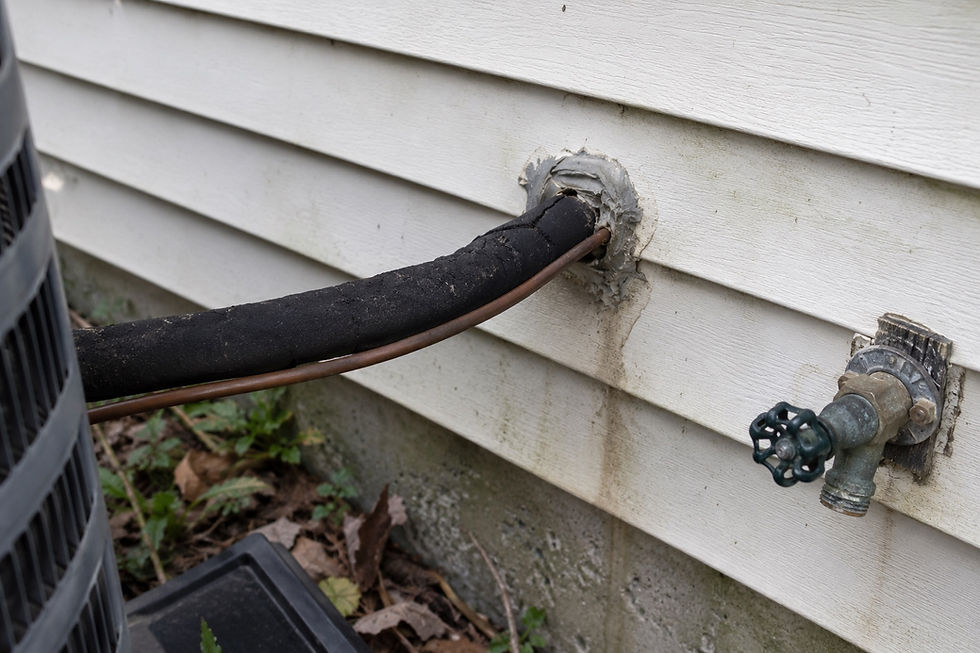
Picture the two halves. An outdoor unit on a pad beside the house. An indoor coil sitting above your furnace, or inside an air handler. Between them runs a pair of insulated copper tubes called the line set. Refrigerant circles that loop forever, flipping from liquid to vapor and back again, and each pass hauls a load of heat across the shell of the building.
The physics underneath is ordinary. A liquid soaks up a great deal of heat when it boils, and hands that heat back when it condenses. All the compressor and the expansion device do is decide where in the loop each of those two events happens. In cooling, the refrigerant boils in the indoor coil and strips heat out of the air moving across it, then condenses outdoors and dumps that heat into your yard. A heat pump bolts on a reversing valve so the same loop runs the other direction in January, boiling refrigerant outside at temperatures well below freezing and condensing it indoors to warm the rooms. The Department of Energy's description of how a heat pump moves heat instead of making it is the shortest honest version of that cycle.
Two consequences matter to you. A sealed loop has no appetite, so a system losing refrigerant has a leak and nothing else. And the specific fluid in that loop sets the operating pressures, the capacity of every component and the oil the compressor swims in. Changing refrigerants is nothing like changing brands of motor oil.
Why R-410A Had to Go
R-410A is leaving new residential equipment because of what it does after it escapes into the atmosphere, not because anything is wrong with how it works inside a heat pump.
R-410A did its job for two decades. It arrived to replace R-22, the old refrigerant that ate at the ozone layer, and on that count it was a clean win. R-410A carries no chlorine and does nothing to ozone. The trouble is a separate one. It traps a lot of heat when it gets loose.
Congress wrote the response into the American Innovation and Manufacturing Act of 2020, which directs EPA to phase down production of hydrofluorocarbons and to restrict high global warming potential refrigerants one sector at a time. The piece of that work which reached your driveway is the Technology Transitions program. For residential and light commercial air conditioning and heat pump systems, EPA set a global warming potential ceiling of 700 with an installation compliance date of January 1, 2025, laid out in its table of HFC restrictions by sector. The phrase residential and light commercial is EPA's own category name for a class of equipment, not a hint about what any one contractor works on.
So manufacturers had to pick a refrigerant under 700 for the equipment they build now. Daikin and most of the Japanese manufacturers went to R-32. Several American brands went to R-454B. A homeowner collecting quotes this year will see both, and both are legitimate answers to the same rule.
What GWP Means and Why Regulators Use It
Global warming potential is one number comparing how much heat a gas traps against the same mass of carbon dioxide, and the 700 line in EPA's rule is exactly where R-410A fails and R-32 passes.
EPA defines it plainly. GWP measures how much energy the emission of one ton of a gas will absorb over a given span of time, compared against one ton of carbon dioxide, which sits at 1 by definition. The span is normally a hundred years.
EPA publishes the values it uses. Its reference table lists R-410A at 2,088 and R-32 at 675. Efficiency, pressure and capacity have nothing to do with it. GWP is a leak penalty, nothing more. A pound of refrigerant that stays sealed inside copper for the entire life of the equipment does nothing to the atmosphere at all. Rules get written against GWP because regulators have to plan for the pounds that do not stay sealed.
Look at how tight the margins are. R-32 clears a limit of 700 by twenty five points. The same EPA table puts R-454B at 465 and R-452B at 698. All three are under the ceiling, all three fall in the same safety class, and which one is inside the box you buy is a manufacturer's engineering decision rather than something a homeowner picks.
A2L and What Mild Flammability Means Beside a House
How the Safety Classes Get Assigned
A2L is a refrigerant safety classification rather than a warning sticker, and it means lower toxicity paired with the mildest flammability category the standard recognizes.
The classifications come from ASHRAE Standard 34, which is maintained alongside Standard 15, the safety standard for refrigeration systems. The letter carries toxicity. A is the lower toxicity group, B the higher one. The number carries flammability. Class 1 refrigerants do not propagate a flame under the standard's test. Class 3 includes propane, which is what sits in the tank under a backyard grill. Class 2 is in between, and 2L is a subclass of it reserved for refrigerants whose flame crawls, with a maximum burning velocity under ten centimeters per second.
Put your two refrigerants on that grid. R-410A is A1. It will not carry a flame in the test. R-32 is A2L. It can burn, under conditions that are genuinely hard to produce on purpose, and it burns slowly when it does. UL's own summary of the shift describes A2L refrigerants as slightly more flammable than today's A1 refrigerants but much less flammable than A3 refrigerants such as R-290, which is propane.
That gap is the whole reason the industry could move at all. A refrigerant with no flammability and a GWP under 700 does not exist in a form that works in a residential split system at a sane price. Mild flammability was the trade, and the equipment was redesigned around it.
What A2L Changes About the Equipment
The A2L classification is why new outdoor units and indoor coils are engineered and listed differently, and nearly all of that work is invisible once the system is running.
The governing safety standard for these appliances in the United States and Canada is UL 60335-2-40. It sets a charge limit tied to the smallest occupied room volume the indoor section serves, with a safety factor of four built in so that a complete release would dilute well below the concentration at which the refrigerant could ignite. It requires that the appliance carry no internal ignition sources. Sealed electrical compartments, relays and contactors chosen for the duty, motor selections that keep a spark away from a possible release. None of it shows up in a brochure.
Codes moved on a slower clock than EPA did, which is the part that catches permit offices. Through the 2021 editions, the model mechanical and residential codes did not allow A2L refrigerants for comfort cooling except in narrow cases. The provisions arrived with the 2024 I-codes, and the code council published a separate document spelling out the changes a jurisdiction still on the 2021 residential code needs to adopt to catch up. Maryland counties do not all enforce the same edition at the same moment, so the practical question on your job is which edition your county's inspector is working from and whether your installer has already pulled permits for A2L equipment under it.
What It Does Not Change About Living With a System
An A2L system asks nothing new of the homeowner, and the outdoor unit goes where the old outdoor unit stood.
The constraints land on the contractor. Charge limits against room volume, mounting heights for the indoor section, clearances from the manufacturer's installation instructions, detector wiring. A competent installer handles every one of those during design and never mentions them to you, the same way nobody explained the gas pressure on your furnace.
What changes for you is short. Refrigerant is not a homeowner serviceable item on any system, and that was true of R-410A too. Keep the space around the outdoor unit clear to whatever the installation instructions require. And if the system ever does lose charge, the person who opens it needs to be certified and needs tools rated for the refrigerant, which rules out the cheapest option in the phone book.
One thing worth hearing plainly. A2L refrigerant has been running in residential equipment in Japan and across Europe for more than a decade. The United States is late to this transition, not first into it.
What Changed in the Equipment and on Install Day
Leak Detection Built Into the Box
Listed A2L equipment ships with a factory installed refrigerant detector and an automatic mitigation response, and that is the largest functional difference between a unit built three years ago and one built now.
The detector is not an add on. UL describes it as a factory installed, indicating device whose set point is factory set and sealed, with no field adjustment permitted, required above a prescribed charge size for systems serving occupied space. It has to react before the refrigerant concentration reaches a quarter of the level at which the gas could ignite. It runs a self test every hour to prove it still works. If the detector itself fails, the equipment drives the circulation fan into a fail safe mode and keeps it there until somebody replaces the sensor.
Mitigation is deliberately unglamorous. The blower runs and moves air. Diluting a release below the flammable range is the entire strategy, and it works because the charge in a residential system is small against the volume of a house.
What you might actually notice someday is a blower that starts when nothing asked for heating or cooling, or a fault code on the thermostat you have never seen. That is the system telling you it has detected something. It is a reason to call the installer, not a reason to leave the house.
Line Sets, Reuse and Pressure Testing
The R-410A line set already running through your wall can sometimes stay for an R-32 system and sometimes cannot, and that call gets made on your house rather than looked up in a table.
The chemistry is friendlier than the last transition. R-410A and R-32 both run on polyol ester oil, so there is no mineral oil residue problem of the kind that made R-22 line sets so troublesome to reuse. Helpful, and not sufficient.
Five things have to be true before reuse is defensible. The tube diameters have to match what the new equipment calls for at its capacity, which is not automatic when the tonnage changes. The run has to fall inside the manufacturer's allowed length and vertical lift. The tubing has to be rated for the operating pressures, and R-32 runs in the same neighborhood as R-410A with a little more on the discharge side. The interior has to be clean. And the whole assembly has to hold a nitrogen pressure test and then pull down to a deep vacuum measured on a micron gauge, not judged by the sound of the pump.
Old brazed joints, a section buried in a slab, a line set that carried R-22 in a previous life. Each is a fair reason to replace instead of reuse, and replacing it is cheaper than chasing a leak through finished walls two summers later. Ask the proposal to say which way it went, and if it says reuse, ask what test was run. The charge and airflow verification steps that follow are the ones ACCA's quality installation standard treats as part of the job rather than as an upsell.
Tools, Training and Service Practice
Opening an A2L system takes the same federal certification as before plus tools and habits built for a mildly flammable refrigerant, which is why not every outfit is set up for this work yet.
The federal floor has not moved. Anyone who buys refrigerant or opens a sealed system needs Section 608 technician certification under the Clean Air Act, and the same section bars intentional venting during service or disposal. EPA's refrigerant sales restriction is what keeps cylinders out of the hands of people without that card.
What sits on top of it is specific. Recovery machines, vacuum pumps and manifold gauges rated for A2L. Leak detectors that will not arc. Cylinders with left hand valve threads and their own color so nobody grabs the wrong one. Ventilation while charging. No open flame anywhere near a possible release, which rules out brazing habits that were fine on R-410A.
One genuine simplification comes with R-32. It is a single compound, not a blend, so the mixture left behind cannot shift composition when some of it escapes. R-410A is a blend of R-32 and R-125, and a leaking blend can change what remains. Weighing in the charge against the data plate is still the only correct way to set it, on either refrigerant.
TerraStream Energy installs Daikin and Goodman equipment on R-32, and keeping to one refrigerant across the whole equipment list is what makes a charging procedure and a tool kit repeatable from house to house instead of a decision crew makes in the driveway.

The Part That Costs Homeowners Money
Why an R-32 Unit Cannot Use Your Old Coil
You cannot set a new R-32 outdoor unit on the R-410A indoor coil already sitting in your basement, and that single sentence is where the refrigerant change turns into money.
Four reasons stack up, and any one of them would be enough.
The metering device is wrong. The expansion valve or orifice in your existing coil was selected for R-410A pressures and R-410A mass flow. Feed it R-32 and the coil floods or starves.
The coil itself was matched to a different fluid. Internal volume, circuiting, tube and fin geometry were all chosen around R-410A performance.
Published ratings belong to tested pairings. AHRI certifies combinations of outdoor unit, indoor unit and metering device, not boxes in isolation, and each certified combination gets its own reference number in the directory of certified product performance. Nobody tested your hybrid, so nobody knows its capacity, including the contractor who proposed it.
The safety listing covers the system as a system. An R-410A era coil was never part of a UL 60335-2-40 listed A2L assembly, has no provision for the detector, and appears on no manufacturer's approved match list.
The old escape hatch is therefore closed. For twenty years a homeowner with a dead condenser and a decent coil could replace half the system and keep going. Moving to R-32 means outdoor unit, indoor coil, metering device and frequently the line set, as one matched set, with one AHRI reference number covering all of it.
What Is Still Allowed on an Existing R-410A System
The R-410A system you already own stays legal to run and legal to service, and EPA has said so in language a homeowner can read.
Straight from EPA's questions on the HFC phasedown, the 2023 Technology Transitions rule does not limit the use of any existing product or system, and existing systems can still be repaired, including replacement of major components such as a condensing unit or a compressor. The footnote under EPA's own restrictions table says the same thing from the other direction. The installation restrictions apply to new field assembled systems, and components used to repair existing systems are not subject to them.
There is a labeling consequence worth knowing. New replacement components built on a higher GWP refrigerant now have to be marked for servicing existing equipment only. So the R-410A condensing unit that goes onto a fifteen year old system is a service part by label, and it exists for exactly that purpose.
Then the wrinkle that surprises people. EPA's reconsideration of the rule left no installation end date for systems whose specified components were all manufactured or imported before January 1, 2025. Read that carefully. A contractor sitting on pre 2025 inventory can still sell you a brand new R-410A system, legally, today. It will work. It will also be a new system running a refrigerant whose production is winding down under a federal phasedown schedule. If a quote looks unusually attractive this year, ask which refrigerant it is built on before you ask anything else.
Supply is the long tail of all this. R-410A keeps reaching the service market from remaining stock and from reclaimed refrigerant, and that flow does not stop on a date. It narrows. Anyone planning to keep an R-410A system for another decade should plan around a refrigerant that gets harder to source rather than easier.
Buying Now Against Keeping What You Have
The real comparison is not R-410A against R-32, it is how many more years you intend to own the equipment in your basement, and the refrigerant only shapes what happens in between.
Question | Keeping an R-410A system running | Buying a new R-32 system |
|---|---|---|
Legal to operate and service | Yes, EPA's rule does not limit use of existing systems | Yes, this is what new residential equipment is built on |
Can one half be replaced | Yes, with an R-410A component labeled for servicing existing equipment only | No, outdoor and indoor are installed as one matched combination |
Refrigerant sourcing over time | Remaining stock and reclaimed refrigerant, narrowing under the phasedown | In current production for new equipment |
Safety classification | A1, no refrigerant detection requirement | A2L, factory detector and fan mitigation on listed equipment |
Line set | Stays where it is | Verified for size and pressure, tested, then reused or replaced |
Who may open the system | EPA Section 608 certified technician | Section 608 certification plus A2L rated tools and training |
What to get in writing | The refrigerant and factory charge from the data plate | Refrigerant, full model numbers and the AHRI reference number |
What the refrigerant change means for two different homeowners
Run the arithmetic on your own house rather than on a rule of thumb. A system with a few good years left and no leak history owes you nothing, and replacing it to get ahead of a refrigerant rule is a weak reason on its own. A system that has already needed refrigerant added twice is telling you something, and on that system the money spent chasing a leak buys you nothing permanent.
The decision also changes shape if you are thinking about heating and not only cooling. Swapping a furnace and air conditioner for a new furnace and air conditioner keeps you on gas. Converting to a heat pump puts heating and cooling in one machine and takes the gas burner out of the house. Those are different projects with different consequences, and the proposal should say in plain words which one it is quoting. The ENERGY STAR criteria for air source heat pumps are the right place to see what the better equipment is held to at low outdoor temperatures, which is the condition a Maryland winter actually tests.
Reading the Data Plate and the Proposal
What the Outdoor Unit Data Plate Tells You
Everything you need to know about the refrigerant you own right now is printed on a plate on the side of the outdoor unit, usually near the service valves.
Walk out and look. Five lines matter.
Refrigerant. It will read R-410A, R-22 or R-32. This is the line the whole conversation turns on.
Factory charge, in pounds and ounces. This is what a correct recharge weighs, and it is the number a technician should be weighing against.
Design pressures, high and low side, in psig. Relevant when anyone proposes reusing the line set.
Model and serial number in full. The date of manufacture is coded into the serial on most brands, which is how you find out the real age of the equipment rather than the age the previous owner told you.
Safety marking. A2L equipment carries additional flammability marking near the plate or the service ports, which is the fastest way to tell what you are standing in front of.
Take a photograph close enough to read the model number. That one picture answers most of what any contractor will ask you on the phone, and it keeps the first conversation about your actual equipment instead of a guess.
If the plate says R-22, the calculus is different and harsher. Production of that refrigerant ended years ago, the remaining supply is reclaimed, and a significant leak on an R-22 system is a replacement decision rather than a repair decision.
What to Look for on a Proposal
A proposal that does not name the refrigerant, list full model numbers and carry an AHRI reference number is not a document you can compare against anything.
Ask for five things in writing, and treat a reluctance to put them in writing as the answer to a different question.
The refrigerant, spelled out. R-32, R-454B or R-410A. If it is R-410A on a new system, you want to know why.
Full model numbers for the outdoor unit, the indoor coil or air handler, and the thermostat.
The AHRI reference number for that exact combination, which you can look up yourself in the certified products directory at your kitchen table.
The line set decision, reuse or replace, and the test behind it.
The commissioning numbers the crew will record on the day. Weighed charge, subcooling, superheat, static pressure and measured airflow.
"The refrigerant line belongs on page one of a proposal, not buried in a model number nobody decodes. A homeowner should be able to read our paperwork and tell me what fluid is in the system, what the factory charge weighs, and which two pieces of equipment were tested together to earn the rating we printed. If I cannot write that down, I have not finished designing the job." Jake Mazzoccoli, Owner, TerraStream Energy
Two Maryland specifics belong on the same checklist. Verify the contractor's state credential through the Maryland Department of Labor, which publishes the HVACR licensing requirements and lets you check a license. And confirm that a mechanical permit is being pulled under whichever code edition your county enforces, because A2L equipment is exactly the case where editions differ.
Incentives deserve one careful paragraph and no promises. Federal credit rules and state program terms change, sometimes mid year, and anything you read about a specific amount is a snapshot. Check the current list of Maryland Energy Administration programs and your utility's current residential offerings before you build a number into your own budget, and confirm the terms in force on the date you sign. One practical note. Program eligibility is usually written against specific model numbers and rated performance, so a proposal that lists the full model numbers is also the proposal you can actually test against a program rule. A quote that says three ton heat pump cannot be checked against anything.
How TerraStream Energy Would Approach This
The first move is reading the plate on the equipment you already own. TerraStream Energy reads it before quoting anything, since the refrigerant printed there decides which of two conversations follows. An R-410A system in good condition with no leak history is worth keeping, and saying so costs nothing. An R-410A system that has been topped off more than once, or an R-22 system of any description, is a replacement conversation whether or not a refrigerant rule existed.
From there the design comes before the equipment. A Manual J load calculation, which is the room by room heat loss and heat gain method the industry sizes residential equipment with, tells you the capacity the house actually needs. Existing equipment is a poor guide, since the system in the basement was often sized off a rule of thumb a generation ago. TerraStream Energy measures the house and sizes from the load rather than matching the tonnage on the old data plate.
Then the matched combination. TerraStream Energy writes the full model numbers and the AHRI reference number for the exact pairing onto the proposal. The rating on that page then belongs to a combination somebody actually tested, not to a tonnage. TerraStream Energy works across Maryland with Prince George's County first, and the heating and cooling work is whole system replacement and conversion off gas or oil heat onto an electric heat pump in single family homes. Repairs, service agreements, duct projects and ductless equipment fall outside that. A homeowner who needs one of those is better served by a contractor or specialist who does it every day.
On the line set, the answer is whatever the test says. TerraStream Energy checks diameter against the new equipment's requirement, verifies the run against the manufacturer's allowed length and lift, and pressure tests before anybody decides to reuse it. Replacement is the recommendation when the existing set cannot be proven sound, and the reason goes in writing.
On install day the numbers get recorded. Weighed charge against the data plate, subcooling and superheat, static pressure and measured airflow, controls configured and the detector verified operational. TerraStream Energy hands those readings to the homeowner as part of the paperwork, because a system that was commissioned and a system that merely got turned on look identical for about one season.
A conversion costs more than a like for like swap. That is honest and it is unavoidable, since a conversion replaces both the heating and the cooling side at once and sometimes the electrical feed with it. For homeowners who would rather not carry a large equipment cost up front, financing through the Palmetto Comfort Plan lease is one route to the same system without one.
If you are holding a quote with R-410A or R-32 printed somewhere on it and you want a plain reading of what you are being sold, call TerraStream Energy at 703-772-5970 or send the proposal through the contact page. Bring the photograph of your data plate. That is where the useful part of the conversation starts.
Frequently Asked Questions
Do I have to replace my R-410A system now?
No. EPA states that the 2023 Technology Transitions rule does not limit the use of any existing product or system, and that existing systems can still be repaired, including replacement of major components such as a condensing unit or a compressor. The restrictions apply to installing new systems, not to running the one you own. What does change over time is sourcing. R-410A reaches the service market from remaining stock and reclaimed refrigerant, and that supply narrows under the federal phasedown rather than disappearing on a date. A sound system with no leak history is worth keeping. A system that has needed refrigerant added more than once is a different conversation.
Can I just replace the outdoor unit and keep my existing indoor coil?
Not with an R-32 outdoor unit. The expansion valve or orifice in an R-410A coil was selected for different pressures and mass flow, the coil geometry was matched to a different fluid, the AHRI efficiency rating belongs to a tested combination rather than to a single box, and an R-410A era coil was never part of a listed A2L system. You can still replace one half of an existing R-410A system using an R-410A component, which is now built and labeled for servicing existing equipment only. Going to R-32 means outdoor unit, indoor coil and metering device together.
Is R-32 dangerous to have beside my house?
R-32 is classified A2L under ASHRAE Standard 34, which means lower toxicity and the mildest flammability category the standard recognizes, with a maximum burning velocity under ten centimeters per second. UL describes A2L refrigerants as slightly more flammable than A1 refrigerants and much less flammable than propane. Equipment is listed under UL 60335-2-40, which sets charge limits against room volume with a safety factor of four, bars internal ignition sources, and requires a factory installed detector that triggers a fan to dilute any release. A2L equipment has been in homes in Europe and Japan for over a decade.
Can my existing line set be reused for an R-32 system?
Sometimes. R-410A and R-32 both use polyol ester oil, so there is no mineral oil residue problem like the one that plagued R-22 changeovers. Reuse still has to be earned. The tube diameters must match what the new equipment calls for at its capacity, the run must fall inside the manufacturer's allowed length and vertical lift, the tubing must be rated for the operating pressures, the interior must be clean, and the assembly must hold a nitrogen pressure test and pull to a deep vacuum on a micron gauge. Buried sections and old brazed joints usually argue for replacement.
Could a contractor still sell me a new R-410A system in Maryland?
Yes, and this surprises people. EPA's reconsideration of the rule left no installation end date for systems whose specified components were all manufactured or imported before January 1, 2025. A contractor holding pre 2025 inventory can legally install a brand new R-410A system today. It will work. It will also be new equipment running a refrigerant whose production is winding down under a federal phasedown schedule, which affects what servicing it looks like years from now. If a quote looks unusually attractive this year, read the refrigerant line before anything else.
Who installs R-32 systems in Maryland?
Any licensed Maryland HVACR contractor whose technicians hold EPA Section 608 certification and who has invested in A2L rated recovery equipment, gauges and leak detection can install them, and you can verify a license through the Maryland Department of Labor. Ask whether the company has already pulled mechanical permits for A2L equipment in your county, since code editions differ. TerraStream Energy installs Daikin and Goodman systems on R-32 across Maryland with Prince George's County first, as whole system replacement or as a conversion off gas heat onto an electric heat pump in single family homes.


Comments